
Caves, Pigs, and Sharks!
- Shaun Yeo

- Mar 31
- 10 min read

The Bahamas has been on my bucket list for a long time, mainly for the famous Abaco caves, but also for sharks… and, of course, the swimming pigs!
Nassau
The easiest route I found to the Bahamas was via London to Nassau, which became the first stop on my dive trip, and it turned out to include several things I’d been hoping to experience.
One of my top priorities was diving the Ray of Hope wreck, known for being home to numerous Caribbean reef sharks. But before that, I started with wall dives on the reefs, and to my surprise, I encountered sharks there too.

What really stood out wasn’t just seeing them, but their behavior. Instead of keeping their distance, they swam curiously toward us, then turned away and circled the group throughout the dive. It was something I hadn’t experienced before. At first, it felt slightly uncomfortable, but as the dive went on, I began to appreciate just how misunderstood these animals are. In other parts of the world where I’ve dived with sharks, they’ve usually been far more timid.
These reef walls form part of an area in Nassau known as the Tongue of the Ocean, a dramatic underwater trench descending to depths of around 2,000 meters.
I dived the Ray of Hope twice during my stay, along with four other wrecks, five in total. However, three of those wrecks were done with a macro lens, so I only captured wide shots of two of them.
It was also my first time seeing Caribbean reef sharks up close. Around the Ray of Hope and the nearby Bahama Mama wreck, I also spotted nurse sharks.

After the dives, I headed to Rose Island to meet one of the Bahamas’ most famous attractions, the swimming pigs. They may not be able to fly… but they can definitely swim!
Abaco
Day 1
After years of dreaming, I finally arrived in the Abaco Islands.
The first task was preparing and analyzing all the tanks at the dive center. The caves here are extremely fragile, with some tight passages, so only sidemount diving is allowed. I prepared two sets of sidemount tanks for the day’s dives, along with an oxygen tank for accelerated decompression. The sidemount tanks were filled with nitrox.
It’s about a 35-minute drive from Marsh Harbour, (where the main diving operations are based, and where I was staying), to Dan’s Cave.
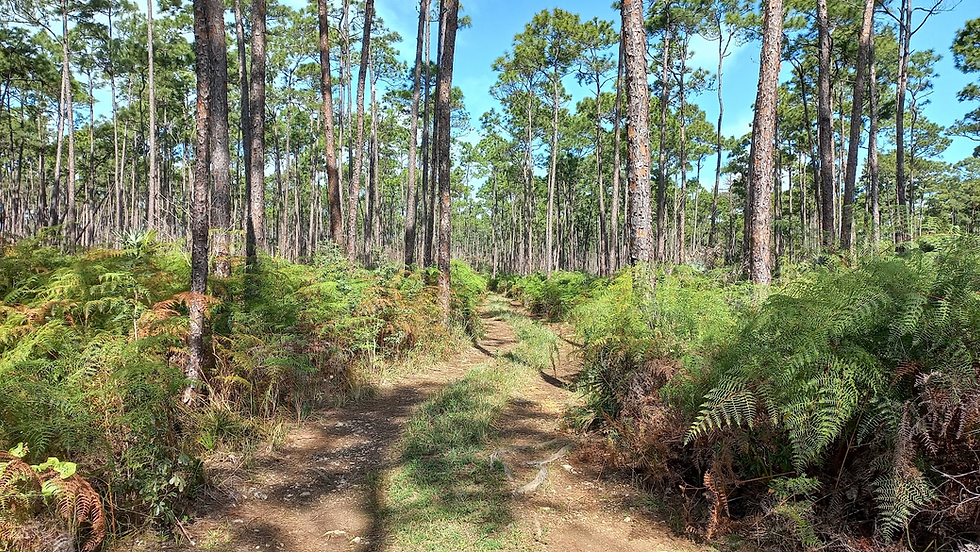
After a long drive south, we turned into a dense forest. Hidden within it are four cave systems.

Our first dive took us into two chambers in Dan’s Cave: Crystal Palace and Cascades Room. Both sit at an average depth of around 24 meters and aren’t far from the entrance. However, to reach the more distant chamber, Crystal Palace, we had to descend through a deeper passage for about two minutes at roughly 36 meters, hence the use of nitrox and oxygen for decompression.
I was incredibly excited for this first dive. I’m comfortable with cave diving and my equipment, but there’s always one concern... the camera. No matter how carefully I prepare it the night before, there’s always that lingering worry that something might fail the moment I hit the water. Thankfully, everything worked perfectly.
The formations were stunning, and the water temperature, around 24°C, was a welcome change from the 14°C I’d been diving in just weeks before at home. Crystal Palace was filled with white, crystal-like stalactites and stalagmites, but this was just a glimpse of what was to come later in the week.
In the Cascades Room, we spent time exploring and photographing the chamber, which is dominated by large columns and intricate formations.
Decompression on this dive was minimal, just under 10 minutes on oxygen.

After a 90-minute surface interval, we returned for a second dive with fresh tanks. This time, we jumped off the main line and explored a more delicate section of the cave.
The passages were tighter, requiring precise movement. It was immediately clear why backmount configurations aren’t suitable here.

We navigated through multiple T-junctions, passing markers (“cookies”) used during previous mapping and survey work. Along the way, I noticed something fascinating, shells embedded in the cave walls and scattered across the floor.
These are remnants of an ancient seabed. Millions of years ago, marine debris, shells and sea creatures, compressed into limestone. Tectonic movement eventually raised this limestone above sea level, and over time, rainwater filtered through it, carving out the cave systems we see today. What remains are fossilized traces of that prehistoric ocean floor. In some places, you can even make out reef structures and coral formations.

Even more intriguing was the shift in color. Some formations had a distinct orange hue, caused by ancient dust carried all the way from the Sahara Desert. During dry periods millions of years ago, winds transported sand across the Atlantic. Over time, this material filtered through the porous limestone, tinting the formations and leaving layers of what is now essentially “Saharan mud.”
Again, decompression was just under 10 minutes.
Day 2
We returned to Dan’s Cave, which contains around 12 miles of laid line, an enormous system.
This time, we did a single long dive using a stage tank. In total, I carried four tanks: two sidemount back gas, one travel gas, and one decompression gas. The goal was distance, to reach a chamber further into the system.

That chamber was the Sanity Room, named by explorer Brian Kakuk after a song he was singing in his head, when he discovered it.
As soon as we entered, the atmosphere changed dramatically. The formations here were a deep orange, and the walls were dark brown to almost black, completely different from the brighter sections we’d seen before.
This also changed how I approached photography. In brighter caves, reflective surfaces bounce strobe light back easily, so I usually reduce power. But here, I had to increase it to properly illuminate the darker surroundings.
It was an incredible dive, both visually and technically.
Day 3
Close to Marsh Harbour lies Hilton’s Blue Hole, a site we had been driving past every day. In fact, it’s so close to the road that at one point, Brian Kakuk had to request the road be moved slightly, to protect the site.

The cave is named after a local man, Hilton, who once hunted pigs in the area.
While the cave itself isn’t visually spectacular, its water has a green tint and the formations are less impressive, but it holds something far more valuable: a window into the past.

Just off the main line, I saw the skeletal remains of a crocodile, carbon dated to around 4,000 years old. There are reportedly multiple skeletons in this system, and nearby caves have revealed dozens more, along with turtle shells and other fossils.
We reached nearly 40 meters on this dive. During our ascent, Brian pointed out what looked like oddly shaped rocks on the cave floor. I assumed they were fallen formations, but later learned they were fossilized crocodile droppings.
I was also shown fragments of ancient turtle shells.
Since this cave is relatively small, we planned a second dive that day, returning once again to Dan’s Cave.

This was a shorter dive. At the first T-junction we’d been using over the previous days, we changed direction and headed toward a chamber known as the Ice Cream Room, filled with beautiful white formations.
From there, we passed through an area called Popcorn Passage, where the walls and floor are covered in popcorn-like calcite formations. I’ve seen this feature in dry caves before, but never underwater. It was a first, and a fitting end to another incredible day of diving.
Day 4
Today was the biggest dive of the entire trip, and once again, we headed back to Dan’s Cave.

This time, the objective was distance. I carried five tanks: two sidemount back gas tanks, two travel gas tanks, and one decompression tank filled with oxygen. All other tanks contained nitrox.
Before getting into the dive itself, there’s a great bit of history behind Dan’s Cave that I hadn’t mentioned yet.
The cave was originally discovered by a group of cave divers who were also part of a flying club on a nearby island. While flying over Abaco, they, and others they had asked to help, were scanning the forest for blue holes. Eventually, one of them spotted what we now know as Dan’s Cave, hidden deep within the dense forest.

The entrance is almost surreal, a small pond surrounded by thick vegetation, alive with tadpoles and dozens of bright blue butterflies. These are Atala Hairstreak butterflies, and interestingly, they’re poisonous. As caterpillars, they feed on toxic plants, storing the toxins in their bodies as a defense mechanism. Their vivid blue coloring acts as a warning to predators.

We also had to be careful with the plants and trees surrounding the cave. Some are poisonous and can cause nasty rashes if they come into contact with your skin. The one to be most cautious of is known locally as “poisonwood,” which can be identified by its distinctive heart-shaped leaves.
Another interesting detail is that some of the paths we follow through the forest today were originally created by logging companies cutting pinewood. At the time, parts of the area even had rail tracks with steam trains running through them, and it’s said that water for the trains’ boilers was occasionally sourced from this very cave.
But back to the dive.
The chamber we were heading to lay around 700 meters from the entrance and took approximately 50 minutes to reach. The route itself was demanding, with the passage dropping aggressively, first from an average depth of 24 meters down to 36 meters, then rising again before descending even deeper to around 45 meters.

Eventually, we arrived at the chamber: Fangorn Forest, sitting at an average depth of about 20 meters.
Despite the long swim and the cold, (I was diving in a 5mm wetsuit), it was absolutely worth it. The chamber was nothing short of breathtaking. Delicate soda straws, intricate stalactites, and twisting helictites were everywhere. Every direction revealed new formations, each more impressive than the last.
Eventually, we reached our turn pressure and began the long journey back.
What I wasn’t looking forward to, however, was the decompression. By this point, I had accumulated a significant obligation, and I was already freezing. By the time we reached the exit, I still had around 40 minutes of decompression to complete, even with accelerated decompression on oxygen.
Cold and uncomfortable as it was, there’s no question, it was worth every second.
Day 5
The crème de la crème of the trip.
Today’s cave was saved for last, and for good reason. It’s considered the most spectacular of them all, but also the most fragile. In some sections, it’s incredibly tight, and not many divers are given the opportunity to explore it.
Access isn’t guaranteed. Over the course of the week, Brian Kakuk carefully assesses each diver’s skills before deciding whether they’re suitable to enter. The level of care required here is absolute, some of the formations found in this cave exist nowhere else on Earth and have taken millions of years to form. A single careless movement could destroy something truly irreplaceable.
Only a handful of cave divers have ever explored the Glass Factory, some even say that more people have summited Mount Everest than have ventured into this extraordinary place.
Before the dive, we had a long and detailed briefing. Every movement was planned, how to position ourselves, how to pass through restrictions, and how to avoid damaging the cave. In some of the tighter sections, we would need to move while negatively buoyant, carefully pulling ourselves along using just our fingertips instead of swimming.
Because of the size of my camera rig, Brian kindly offered to carry it through the most delicate sections to reduce the risk of accidental contact. At key points, he would pass it back to me so I could capture the formations.

The cave itself was discovered by a local pig hunter named Ralph. While out in the forest with his dogs, one of them suddenly disappeared. Following the sound of barking, Ralph found that the dog had fallen into a sinkhole, revealing what would later become one of the most extraordinary cave systems in the Abaco Islands.
To reach the main chamber, we used a travel gas before arriving at a beautifully decorated room known worldwide as the Glass Factory. Here, we dropped the travel tank and switched to our sidemount back gas to begin exploring.

Almost immediately, we were surrounded by curtain-like formations, so thin and translucent that when Brian placed his hand behind one, I could clearly see its outline through the rock. It was astonishing.

Across the chamber, the floor revealed what were once shallow pools, now filled with intricate crystal formations. They reminded me of similar features I’d seen in Ragged Staff Cave (Gibraltar), though seeing them underwater added an entirely new dimension.

One of the most fascinating sights was the fossilized remains of two bats, estimated to be over 14,000 years old, embedded within the flowstone on the cave floor. I’ve seen bat skeletons before, such as in caves in the Dominican Republic, but never preserved like this, fused into the very formations themselves.

As we continued, we entered a section filled with thousands of incredibly delicate soda straws. Many describe it as “diving inside a chandelier,” and it’s an accurate description. Crystal-like formations surrounded us in every direction. Here, we had to move extremely carefully, negatively buoyant and slowly crawling along the floor to avoid contact.

This area also revealed something truly unique: rose formations, found nowhere else in the world. These began as downward-growing soda straws formed by dripping water. When they reached a pool below, crystals formed at their tips, creating shapes that resemble roses. Over time, geological shifts caused the cave floor to drop, leaving these delicate “roses” suspended from the ceiling.
Eventually, we reached our turnaround point, passing once more through dense clusters of fragile soda straws, what Brian fittingly calls “frozen rain.”
By the end of the dive, I was completely in awe. The beauty of these caves is beyond words.
But what made the trip even more remarkable was the contrast, just a week earlier, I had been diving alongside sharks in the open ocean. From reef predators to ancient underground worlds, this journey had delivered something truly special.
I hope to return to The Bahamas one day, not just for cave diving, but to explore more of the islands I didn’t have time to visit. Some of them are known for encounters with hammerhead sharks, lemon sharks, and even tiger sharks.
Below are a few videos I’ve put together from the trip. The Dan’s Cave video is quite long, as it combines footage from five separate dives, but it captures the experience as a whole:


Pulau Komodo planning often centers on destination variety, but stop duration at each island may carry more influence than expected. Shorter exploration windows across multiple locations could reduce observation depth. Some external itinerary breakdowns suggest different pacing structures, though the reasoning behind those allocations remains somewhat open.